
If you have a wound that is taking too long to heal, it can feel scary and exhausting.
You keep checking it.
You worry about infection, scarring, pain, and whether you’re doing the right thing.
This is where red and near-infrared light therapy, also called photobiomodulation, can help support the body’s natural repair process.
But I want to be clear from the beginning:
Red light therapy is not a replacement for wound care, antibiotics, surgery follow-up, diabetes care, or a doctor’s advice.
It may be useful as a support tool, especially for tissue repair, inflammation, circulation, and healing after the wound has been cleaned and medically checked.
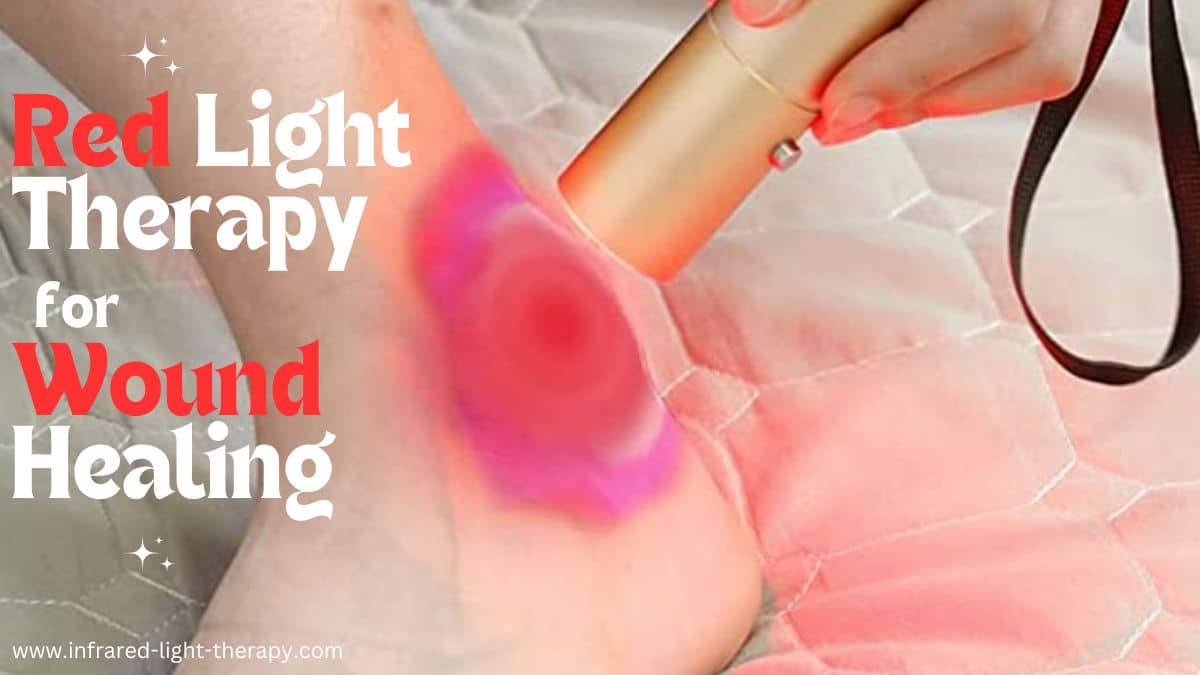
Research on photobiomodulation for wound healing is promising, including studies on chronic wounds and diabetic foot ulcers.
But at-home treatment should be done carefully and with realistic expectations.
A review on red and near-infrared photobiomodulation describes it as a promising drug-free approach for supporting wound healing, inflammation reduction, and tissue repair, but not as a stand-alone replacement for medical care.
In this guide, you’ll learn:
- How red light therapy helps wounds heal
- Which devices you can safely use at home
- And how to use them correctly for the best results
👉 In a Hurry? Here’s the Safe Starting Point
If your wound has been medically checked and you want to try red light therapy at home, here’s how I would choose:
Jump to the best ways to use red light therapy for wounds – at home!
This post may contain affiliate links that earn us a small commission at no extra cost to you.
Overview
Can Red Light Therapy Support Wound Healing?
Red and near-infrared light can definitely help cells involved in wound repair work better.
The main mechanism is photobiomodulation: light is absorbed by parts of the cell, including mitochondria, which can increase cellular energy signaling and support repair processes.
Research has looked at PBM for different wound types, including chronic wounds, surgical wounds, oral wounds, and diabetic foot ulcers.
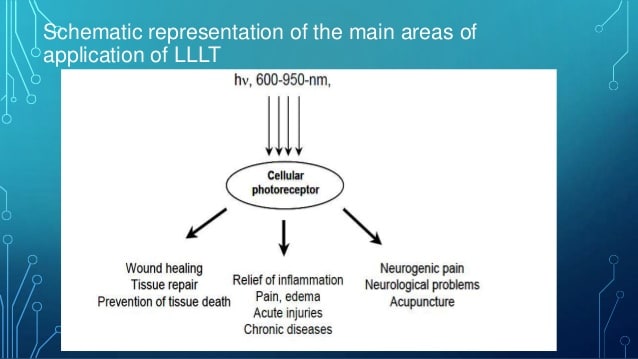
A 2024 review specifically notes that PBM research for diabetic wound healing is active and ongoing, especially around inflammation pathways.
But the important part is this:
Research devices and clinical protocols are not the same as every home device sold online.
So when using red light therapy at home, the goal is not to “force” a wound to close overnight.
The goal is to support the natural healing process safely and consistently.
Here’s How Red Light Therapy Affects Wounds
Infrared light therapy is described by science in terms of wavelength, measured in nanometers.
Any number between 620 nm and 680 nm is visible red light.
Any number between 700 and 1100 is invisible near-infrared light.
Here’s how it works:
1. Cellular energy support – Photobiomodulation can affect mitochondrial activity and ATP-related signaling, which can support cells involved in tissue repair.
2. Inflammation balance – some research suggests PBM can help regulate inflammatory processes, which is important because wounds need inflammation early, but too much or prolonged inflammation can slow healing.
3. Microcirculation – Red and near-infrared light can boost local blood flow and tissue oxygenation, which are important for repair.
4. Collagen – as a wound closes, collagen remodeling becomes important for tissue strength and scar quality. Red light therapy is often studied in this repair/remodeling stage.
(I also explain the better-supported red light therapy skin benefits here, including skin texture, collagen support, and what is probably overhyped)
5. Pain and comfort – some people also report less discomfort around healing tissue, but pain that is worsening, severe, or sudden should always be checked medically.
Do not think of red light therapy as “healing the wound by itself.”
Think of it as a support tool for the repair environment.
What Wavelength Works Best for Wound Healing?
Most wound-healing research focuses on red and near-infrared light.
Commonly used ranges are:
- 630-660 nm red light: often used for surface-level skin and tissue repair
- 800-880 nm near-infrared: often used when deeper penetration is desired
- 904 nm pulsed laser: used in some clinical PBM studies
Many home devices combine 660 nm and 850 nm, which makes sense for general skin and body use.
But wavelength is only one part of the picture.
For wound healing, these also matter:
- Treatment distance
- Treatment time
- Irradiance or power output
- Total dose
- Whether the device produces heat
- Whether the wound is open, closed, infected, surgical, diabetic, or superficial
This is why I don’t recommend buying a device only because it says “red light.”
For wound healing, the safest at-home choice is usually a device with clear wavelengths, simple instructions, low heat, and enough coverage to treat the wound area without touching it. 👉 Jump to the devices list
So for home use, I prefer a cautious approach:
short sessions, clean device, no direct contact, no overheating, and medical guidance for anything serious.
Best Ways to Use Red Light Therapy for Wounds (At Home)
If you want to try red light therapy at home, I would choose the device based on the wound type and how sensitive the area is.
For most people, the safest starting point is a red/NIR LED lamp, panel, or handheld device that gives light without intense heat.
I would be more careful with near-infrared heat lamps, because they can get hot and may not be ideal near delicate, numb, diabetic, or slow-healing skin.
Here is the simplest way to choose:
Small Red/NIR LED Lamp – for Small Wounds & Scars
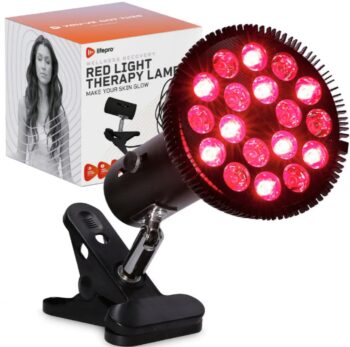
The easiest beginner option is this red & near-infrared therapy lamp (660nm + 850nm), which covers the wavelengths most often used in wound-healing studies.
✅ Best for – small wounds, scars, or healing incisions after medical clearance
❌ Skip if – the wound is infected, deep, or you need a doctor-managed wound-care plan
The LifePro lamp compact red and near-infrared therapy lamp combines two of the wavelengths most commonly used in wound-healing research (660 nm and 850 nm).
This one gets less hot than a near-infrared lamp and is best for heat-sensitive people.
Red/Infrared Hand-Held Device – for Small Spots
✅ Best for – small, targeted areas, scars, and healing skin
❌ Skip if – you need to treat a large wound area or cannot avoid touching the wound
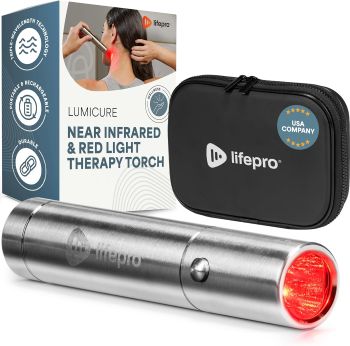
If you want a device that lets you treat a small wound very precisely, the LifePro light therapy device is one of the simplest options.
Several studies have shown that red and near-infrared light therapy can support wound healing by stimulating cellular activity and circulation in damaged tissue.
You can find all of these wavelengths (630nm + 660nm + 850nm) in the LifePro device.
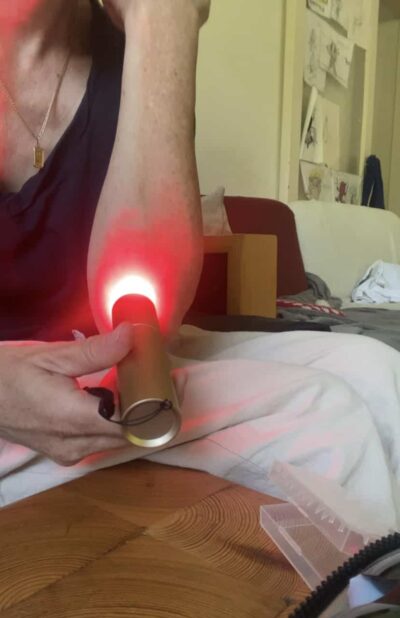
Even if the device is small, I still avoid looking directly at the LEDs and prefer using eye protection when treating near the face.
Personal note: I use small red light devices at home for targeted skin areas because they are easy to control and simple to repeat.
For me, the biggest advantage is consistency: if a device is small, quick, and not messy, I’m more likely to use it every day.
But for actual wounds, especially after surgery or with infection risk, I would always follow medical instructions first and use light therapy only as a support tool.
Red Light Therapy Wand – Gentle and Covers a Larger Area
✅ Best for – people who want a gentler routine for small areas – that is customizable
❌ Skip if – you want the fastest and strongest wound option
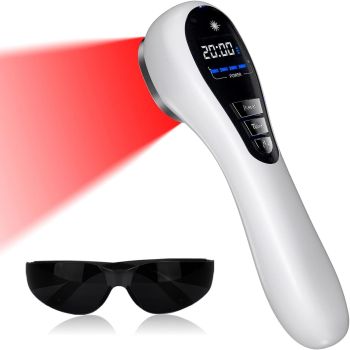
The Holsn red and infrared therapy wand delivers both 650 nm red light and 850 nm near-infrared light and allows longer treatment sessions with adjustable power levels.
Because it offers multiple timer settings and power levels, it can be useful for people who want a more customizable treatment routine.
It is portable and lightweight, and you can use it 2–3 sessions per day for optimal results.
However, I would not automatically start with 20-minute sessions on healing skin.
Start lower, follow the device instructions, and ask your doctor if you are treating a serious wound.
It’s easy to use and customizable – you can choose from 4 power levels and 4 timer options (5/10/15/20 minutes), and it is totally quiet. The only con is that you can’t use it while it’s charging. It even comes with protective glasses!
How Long Should You Do Red Light Therapy on a Wound?
There is no one perfect treatment time for every wound and every device.
The right time depends on the device power, distance from the skin, treatment area size, whether the wound is open or closed, and more.
Many clinical PBM studies use specific doses, often measured in J/cm², but most of us do not have an easy way to calculate that accurately.
So for home use, I would stay conservative:
- Start with short sessions
- Follow the device manual
- Do not use heat that feels uncomfortable
- Do not treat infected or worsening wounds without medical care
- Track changes with photos every few days
For a small, medically cleared area, many people start with a few minutes per session and adjust based on the device instructions and skin response.
If the wound becomes more painful, red, swollen, hot, or irritated, stop and get medical advice.
What Results Should You Expect?
Red light therapy does not close a wound overnight.
The changes are usually gradual.
You may notice:
- After the first few sessions – warmth or comfort around the area, less tightness or irritation, a slight improvement in redness.
- After 1-2 weeks – healthier-looking tissue, more stable-looking wound edges, and less irritation around the area.
- Over several weeks – gradual wound closure, better scar appearance, improved skin texture around the healed area.
If a wound is not improving, do not keep trying home treatments without medical guidance.
5 Common Mistakes When Using Red Light Therapy for Wounds
Red light therapy works best when used correctly.
Here are a few common mistakes that can slow your healing:
- Using the light too far from the skin – Light intensity drops quickly with distance. Most devices work best a few inches away from the skin.
- Using the device too rarely – Photobiomodulation works through consistency. Most studies use daily or near-daily treatments.
- Stopping treatment too early – Even if a wound looks better, the tissue underneath may still be healing.
- Using too much heat – Heat lamps can become very warm. Always keep a safe distance.
- Ignoring basic wound care – LED light therapy works best alongside proper wound cleaning and medical care.
Side Effects and Risks
Red light therapy is generally considered low-risk when used correctly, but it is not risk-free.
Possible problems include:
Eye discomfort or eye injury if you stare into bright LEDs
Skin irritation
Delayed medical care if you rely on it too much
Contamination if a device touches an open wound
Worsening symptoms if the wound is infected or serious
Do not shine the light into your eyes. Use protective glasses when needed, especially near the face.

Avoid red light therapy over cancerous lesions unless your doctor specifically approves it.
And if your wound gets worse, hotter, more painful, more swollen, or starts draining pus, stop and get medical care.
FAQ
Can Red Light Therapy Penetrate a Cast?
The penetration of red-light therapy depends on the wavelength and wattage of the light, as well as the distance and angle.
If you are using a home device, it is unlikely that the device would be powerful enough to penetrate through a cast.
You’ll need a professional device with a high enough irradiance to get through a cast.
Can You Use Red Light Therapy on an Open Wound?
Sometimes, but this is where you need to be careful.
Photobiomodulation has been studied for open and chronic wounds in clinical settings, including diabetic wounds.
But at home, open wounds carry infection and contamination risks.
If the wound is open, deep, diabetic, surgical, infected, or slow to heal, ask your doctor first.
- Do not let the device touch the wound
- Keep the device clean
- Do not use strong heat
- Do not overdo treatment time
- Continue normal wound care
- Watch for worsening pain, redness, heat, swelling, or drainage
Is Red Light Therapy Safe After Surgery?
Only use it after your surgeon or clinician says it is safe. Surgical wounds can have specific instructions, and using heat or light too early may not be good for every case.
Is a Heat Lamp Good for Wound Healing?
A heat lamp may support warmth and circulation around an area, but it also carries a higher burn risk. For wounds, low-heat LED devices are usually easier to control at home.
If you’re considering a bulb-style device, read my infrared heat lamp therapy guide first so you understand the heat, distance, and safety differences
To your health and happiness,
Meital
Studies
Chaves ME, Araújo AR, Piancastelli AC, Pinotti M. Effects of low-power light therapy on wound healing: LASER x LED. An Bras Dermatol. 2014;89(4):616–623.
Light therapy by blue LED improves wound healing in an excision model in rats, Adamskaya, Natalia et al. Injury
Immediate Vascular Photochemical Reactions to Infrared Laser Irradiation in Normal Volunteers. Journal of American Science
Harry T. Whelan, et al. Effect of NASA Light-Emitting Diode Irradiation on Wound Healing, Journal of Clinical Laser Medicine & Surgery.Dec 2001.305-314.
de Alencar Fonseca Santos J, Campelo MBD, de Oliveira RA, Nicolau RA, Rezende VEA, Arisawa EÂL. Effects of Low-Power Light Therapy on the Tissue Repair Process of Chronic Wounds in Diabetic Feet. Photomed Laser Surg. 2018 Jun;36(6):298-304.
Would you kindly send me your E-mail address, as i will have a few import points to ask about using 12w hand held red lamp, or ultrared lamp healing open wound on my leg, no medical what ever they are, will not help.
Hi Lali, please use my contact page here – it goes straight to my email. Thank you.
Does this near light therapy cause an internal hemorrhoid to worsen or help it?
It can only help. It increases blood circulation and brings energy to any area it is pointed to. You just have to use it carefully – not too close.
My son had surgery this past Thursday to remove an infected abscess. It is right above his rectum and he has an open wound about the size of a 50 cent piece that is packed. Would this be beneficial?
According to the studies I have mentioned in the article – yes, it would. Good luck!
Have you had good results using red light therapy with seasonal affective disorder?
Yes, especially by using intranasal red light therapy
What about anal fissures after childbirth. I have a set up of three Phillips heat-ray250watt infrared bulbs.” Do you think this will help even if the fissure is slightly internal? Doctors say I need surgery but I am only 29 but in daily pain. Trying everything! Also, how long should I do treatment?
It may help, though I don’t know about research done specifically for this condition. Infrared light therapy penetrates 2-3 cm into your tissues. You can do the treatment for 20-30 minutes, as long as you feel comfortable. Make sure to keep a safe distance of 24 inches away from the light.
I had abdominal surgery one week ago and have a lot of swelling that is slow to resolve. I have a joove like near infrared panel, should I use that, or wait until swelling goes down?
Yes, red light therapy is proven to promote wound healing. I would try it.
How much time do you think I should do?
About 10-15 minutes a day.
I’m seeing both 1.5 to 5 inches distance and then 12″ to 24″ distance away from wound. which is it?
1.5 – 5 is minutes for treatment, not distance. I hope this helps.
Hello, thank you for this article.
I had laparoscopic abdominal surgery yesterday and have clear large bandaids covering the wounds. Would you suggest waiting a week until I get the bandaids off or can I start red light therapy sooner?
To my knowledge, you can start with the red light before taking off the bandages. Some of the light may penetrate through them.
Hello I had surgery on my foot 6 weeks ago just had cast removed yesterday and there’s still some swelling. Should I wait to use near infrared? Thank you
To my knowledge if you are 6 weeks after surgery you can use the red light to heal your wound. Good luck!
How do I use an infrared hex handheld heat lamp on a pubic boil? Should I use it as the heater for my warm compresses?
You can do that, but to get the benefits of the light you’ll need to point the heat lamp to the boil directly, keeping it at a safe distance of 24 inches.
I have a kind of wound on my lips, a kind of inflammation that the outer layer of the skin of the lips keeps peeling off because of an old wound(both lower and upper lips). Each time a new layer of skin starts to grow, it peels off again because apparently it is a new skin and there is always pressure on the lips hence I have to talk, eat and drink through it. I had the issue twoyears before but after some months and after a lot of vitamin c,and plasma therapy it got heald.
Can the infrared of 100 watts (R95E) help to heal it.
It’s worth a try, but keep it at a safe distance and use safety goggles to protect your eyes. I would also use those vitamins and supplements again since it helped you the last time it happened.
My small dog had a lump removed from his tail and the skin graft did not work, now he has an open wound that we are treating. Would 1 to 2 miniutes, 12″ away everyday, with / without bandages be a good routine for him?
Yes, I think it would. Let me know how it worked o.k? :)
Time recommended for red led light 660nm 12w for bruising?
To my knowledge you can use for 20-25 minutes once a day.
My husband is in a dementia facility & he has had sore buttocks for 3 months, but, now (8 months) he has open ulcers & I have had 4 different doctors look at him–primary, dermatologist, wound specialist and facility medical personnel & they all prescribe different kinds of creams. Now, they have him on a cream that is almost $400.00 an ounce that insurance does not cover. He is in so much pain, he screams every time someone wipes him. I was there yesterday, determined to leave him naked from the waist down, and after 6 hours, free up pull-ups, he seemed better from the air! I am tired of crying every time I visit, because he does not deserve this condition & they won’t do what I say. I am going to buy an infrared light & go there a couple of times per day. I want a hand-held. Thank you for whatever you can suggest!
I have a rather deep surgical wound that will not heal. It still has to be packed and bandaged everyday. Can I use the red light even though my wound is packed and bandaged? Will it be effective at this point? Or should I wait until the wound progresses to the point that it does not have to be packed or bandaged anymore? Thank you for your help.
To be on the safe side, I would consult my doctor about this. However, to my knowledge, it’s safe to use red light wound therapy without the bandage, as long as you keep it in a safe distance. Listen to your body and see how it feels.
Hi,
The local Home Depot and Lowe’s have Red 630, Green 525 and Blue 450 led bulbs at 3W and 8 W. Could I use the 8 W for treatment? I cannot find the power density info for these bulbs to calculate treatment doseage.
To my knowledge these bulbs are not powerful enough for treatment. See this post for more info: https://www.infrared-light-therapy.com/infrared-heat-lamp-therapy/
Hi there,
what do you think about this bulbs ? Which is best ?
TheraBulb Infrared Bulb NIR-A 250 Watt 700 nm to 1200
RubyLux Infrared Bulb NIR-A 250 Watt 850nm
ABI 25W Deep Red LED 660nm
I would go for the RubyLux, but they are all good.
The link you’ve provided does not work so I can’t look at it. As for your cupboard size, it seems a little small to me, and I would only use 1-2 bulbs in it. You have to make sure you’ll be able to keep a safe distance from the light as instructed in the post.
I will try to keep the distance, maybe find bigger cupboard, I think it would be better if it is place for rotating on a chair.
I want to do like on the link, very simply, just piece of board, lamp sockets, lamps, cables and power switch but I want to put it from outside on cupboard.
Please and can you write me the best material for covering an electrical cables-use shielded cables? So how to minimize EMF? Or with infrared lamps is not so bad?
I’m sorry but I’m not very good with electricity, I can’t help you with that. Maybe someone in the community can answer this? As for the EMF, as you can see in the video, the EMF is very low and reduces to none if you keep that safe distance.
I have a 36 watt 660 , how far away should it be from my skin ?
Since it’s low power, just get it close enough to feel comfortable heat.
Can you use and IR illuminator that’s made for night vision cameras? They admit a 850nm of light and are far cheaper than what’s designed for therapy.
That’s an interesting idea…:) However, it’s not thought to be the best wavelength for wound healing – it should be more in the range of red and near infrared wavelength.
I am doing a rotator cuff surgery. I assume I will ice for a couple of weeks.
At what point would one use the red light therapy?
Thx :)
You can use it once there is little to no inflammation in the area. Good luck!
Hello
What would be the best time each day and distant treatment for a deep leg ulcer for a lady who is 88 ?
How many minutes do I use the infared light for foot uclers
From the post: “According to studies, optimal treatment time is 1.5 – 5 minutes per treatment area.” Do this every day for at least 40 days. Good luck!
Hi I live in the UK. I want to purchase a high quality near infrared bulb 250w more or less like ruby but we do not have them over here.
What reputable brand would you recommend?
Riz,
Here’s a page where you can buy one from Amazon.uk:
I would recommend the Wells Poultry one.
I have the light now but will welding glasses protect me well enough from the light? thank you in advance :)
Yes, but in any case just don’t look directly at the light.
How often do I use the 250 watt infrared lamp on on 1/4 inch diameter shallow pressure wound on my bottom. I’m a paraplegic.
I would start with once a day. But, please make sure you keep the light at a safe disatnce of at least 12 inches, because you will not feel if it’s burning your skin. I would also consult my doctor about how to do ths treatment.
Will it cure kidney weaknesses?
Will it cure foot nail fungus etc?
I don’t know about kidney weakness curing, but it can sure help because increasing blood circulation is helpful for any condition, disease, or injury. For nail fungus, it can help as well, but for both, I would use infrared and not red light. See our red light therapy FAQ page for more questions and answers
Hello, will this work for a very bad case if plantar Fasciitis. I have been to 5 doctors inured extremely painful shots, Acupuncture, physical therapy, you name it. I’ve tried it. I have been in alot of pain daily for over 3 years now. It has destroyed my life.
Rafael,
I’m sorry to hear what you are going through, but don’t lose hope just yet. Yes, I think it’s definitely worth a try – read this article that better suits your condition, and follow the simple instructions:
https://www.infrared-light-therapy.com/infrared-heat-lamp-therapy/
Please let me know if the wound has to be uncovered for the light to work or will it still work through a bandaged wound?
Hi:)
To my knowledge it will work through a bandage, though you may need to get the light a bit closer.