
If your main goal is anti-aging, you’ve probably had this exact thought:
Should I buy an LED face mask, or should I just get a red light therapy panel?
I get it.
LED masks look easy.
You put one on, lie back, and feel like you’re doing something good for your skin.
Panels look more serious.
They’re bigger, stronger-looking, and feel more like a real home therapy device.
But which one is actually better for fine lines, dull skin, firmness, and that tired-looking face that suddenly shows up?
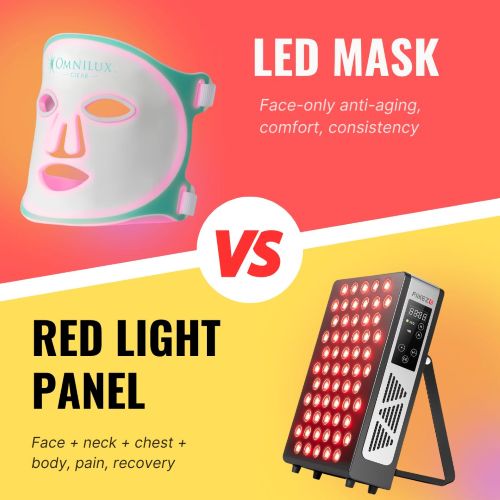
The short answer:
For face-only anti-aging, a good LED mask is usually easier to stick with.
But for versatility, body use, and better long-term value, a red light therapy panel usually wins.
The right choice depends on one simple thing:
What will you actually use consistently?
Because red light therapy is not a one-time facial. The results depend on repeated use over time.
Stanford Medicine notes that wrinkle reduction and hair growth are among the better-supported uses of red light therapy, while also warning that many marketing claims still go beyond the evidence.
LED Mask vs. Panel: Quick Answer
If you only care about your face and know you’ll use a mask several times a week, start with a good LED mask.
If you want one device for your face, neck, chest, joints, back, knees, or general recovery, a good panel makes more sense.
Choose an LED mask if:
- You only care about your face
- You want the easiest routine
- You like relaxing skincare rituals
- You travel often
- You are more likely to use something wearable
Choose a red light panel if:
- You want face and body use
- You want to treat your neck and chest, too
- You also have pain, stiffness, or soreness
- You want more long-term versatility
- You don’t mind sitting in front of a device
Choose both only if:
- You already use red light consistently
- You want a mask for convenience and a panel for body use
- You have the budget
- You know these devices won’t end up in a drawer
👉 Not sure which type of red light therapy device fits your goals? I compare masks, panels, handheld devices, and other red light therapy devices in this guide.
Does Red Light Therapy Actually Help Aging Skin?
Red light therapy is a form of photobiomodulation, which means it uses low-level red or near-infrared light to trigger biological activity in the skin without heating or damaging it.
A skin-focused review in Seminars in Cutaneous Medicine and Surgery explains that low-level light therapy has been used for photorejuvenation, including fine wrinkles and photoaged skin, and that many of these effects are linked to collagen production and dermal remodeling.
Specifically for anti-aging, one randomized clinical trial of 137 women aged 40 to 65 found that photobiomodulation reduced periocular wrinkle volume by 30%.
But this does not mean every LED mask, panel, wand, or cheap red bulb will give you the same result.
The device matters.
The wavelength matters.
The dose matters.
And your consistency matters more than most people want to admit.
👉 If you want the deeper breakdown, I explain the most realistic red light therapy skin benefits here, including fine lines, collagen support, dullness, redness, and what is probably overhyped
LED Masks: Why They’re So Popular

An LED mask is the “I’ll actually do this” option.
That’s the biggest advantage.
- You don’t need to stand in front of anything.
- You do not need to measure distance.
- You do not need to keep moving your chair around to reach different areas.
You clean your face, put the mask on, press start, and let it do its thing.
After treatment, I like using an LED light therapy serum, and I explain what works best with LED light therapy.
That sounds small, but in real life it’s huge.
If you’re tired at night, dealing with work, kids, dishes, laundry, emails, or just the mental load of the day, the best device is often the one with the least amount of resistance.
That’s why I understand the love for LED masks.
When I use one, it feels more like a skincare ritual than a treatment.
It gives me a few quiet minutes where I’m forced to stop, sit down, and do something for myself.
👉 Here’s my latest LED mask review: Project E Beauty Lumalx Face+ Pro
LED Masks Are Best For:
- Fine lines around the eyes and mouth
- Dull-looking skin
- Uneven tone
- Mild redness
- People who want the easiest routine
- People who hate complicated devices
The Problem With LED Masks:
Most LED masks are face-only.
Some cover the jawline nicely, but they usually do not treat the neck, chest, hands, shoulders, or body.
Aging does not stop at the jawline.
The neck starts showing lines, the chest starts showing sun damage, the hands can age faster than the face.
So if you buy only a mask, you may eventually want another device for everything below your chin.
Another issue:
Not all masks are equal.
Some brands clearly state their wavelengths, treatment time, coverage, and safety details.
Others give you vague beauty language and almost no useful specs.
That’s where people waste money.
👉 If you’re leaning toward a mask, see my full guide to the best LED light therapy face masks, including which ones are actually worth considering and who each one is best for.
Red Light Panels: Why They Make Sense for Some People
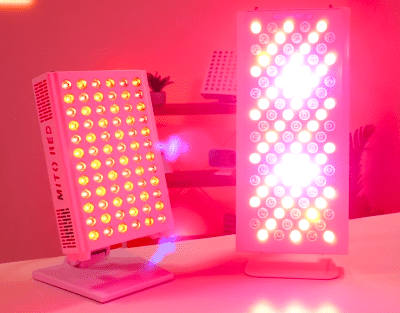
A red light therapy panel is more versatile.
You can use it on your face, neck, chest, stomach, back, knees, hands, feet, shoulders, or anywhere else you can position in front of the light.
That makes it a better choice if your goal is not just “wrinkles.”
For example, if you want to support skin aging and use red or near-infrared light for aching joints, muscle recovery, stiffness, or general wellness, a panel gives you more options.
That’s where panels usually win on long-term value.
You’re buying one device that can fit into a face, body, pain, and recovery routine.
Panels Are Best For:
- Face + neck + chest
- Hand aging
- Full-body routines
- People with pain or stiffness
- People who want beauty and recovery in one device
- Couples or households sharing one device
- Better long-term versatility
The Problem With Panels
Panels require more effort.
You need to set them up.
You need to sit or stand at the right distance and treat one area at a time.
And if you’re using one on your face, you need to follow the manufacturer’s eye-safety instructions carefully (I always use these safety glasses).
A panel can be more powerful and useful, but it is not as relaxing as lying down with a mask.
This is where people make the wrong decision.
They buy the “better” device on paper.
Then they barely use it.
That’s not better.
LED Mask Compared with Red Light Therapy Panels
Comfort: LED Mask Wins
If comfort is your top priority, the LED mask wins.
You can use it while lying on the couch, listening to a podcast, doing breathing exercises, or pretending you’re not avoiding the laundry.
A panel is not uncomfortable, but it is more active.
You have to position yourself.
For anti-aging, this matters because the routine has to become easy enough to repeat.
Winner: LED mask
Consistency: LED Mask Usually Wins
This is probably the most underrated buying consideration.
A mask is easier to be consistent with because it can fit naturally into a skincare routine: Cleanse, use mask, apply serum or moisturizer.
Done.
A panel takes more intention. Not a lot, but enough that many people skip it when life gets busy.
So if you know yourself and you’re thinking, “I barely remember to use my gua sha,” get the mask.
Winner: LED mask
Versatility: Panel Wins
This one is not close.
A mask treats your face.
A panel can treat your face, neck, chest, hands, joints, back, abdomen, legs, and more.
This makes panels much better for people who want anti-aging plus recovery.
And this is where the whole “biohacking beauty” trend makes sense.
People are no longer thinking only about wrinkles.
They’re thinking about inflammation, stress, pain, sleep, and recovery as part of how they look and feel.
A 2025 review describes photobiomodulation as using red or near-infrared light in the 600 to 1100 nm range and discusses its study across skin, musculoskeletal, neurological, and other results.
The evidence is not equally strong for every use, but it explains why people are looking beyond face-only devices.
Winner: Red light panel
👉 If your main goal is a sore knee, elbow, shoulder, or lower back, a wrap may actually be easier than a panel. I compare the best red light therapy wraps here.
Treatment Time: It Depends
Masks are simple because the treatment time is usually preset.
Many run for around 10 minutes, depending on the device.
Panels can treat larger areas and may be more efficient for using on more areas, but they require more positioning.
For example:
- Face with a mask: simple, one session.
- Face + neck + chest with a panel: more coverage, but more setup.
- Back + knee + face with a panel: more useful, but now it becomes a real routine.
Best for simplicity: LED mask
Best for multi-area treatment: Panel
Travel: LED Mask Wins
If you travel often, a mask is easier.
A mask fits in a bag.
A panel usually does not, unless it’s a very small tabletop panel.
If you’re the type of person who loses all routine while traveling, the mask is the more realistic choice.
Winner: LED mask
Price: Panels May Cost Less Than You Think
Here’s the part many people miss:
A small, good-quality red light panel can cost less than a high-quality LED face mask.
I don’t mean cheap Amazon masks with vague specs. I mean well-known, higher-quality masks from established brands.
For example, the CurrentBody Skin LED mask is listed at £299.99-£399.99, and the Face & Neck Kit is listed at £679.99.
By comparison, small panels like the Hooga PRO300 and MitoMIN 2.0 are listed at around $249-$299, with red and near-infrared wavelengths and enough versatility to use on the face, neck, chest, joints, back, knees, and sore muscles.
If a mask makes you consistent, the convenience may be worth paying for.
But if you’re already spending $300-$500, ask yourself:
Do I only want to treat my face, or do I want one device I can also use on my neck, chest, hands, back, knees, and sore muscles?
A small panel can be hard to beat, especially if your goals include both anti-aging and natural pain relief.
My Honest Take
If a friend asked me what to buy, I’d ask one question first:
Are you buying this for your face only, or for your whole body?
Because that usually decides it.
If she said:
“I just want something easy for fine lines, glow, and tired-looking skin.”
I’d tell her to get a good LED mask.
If she said:
“I want anti-aging, but I also have neck pain, shoulder tightness, knee pain, or I want to use it for recovery.”
I’d tell her to look at a panel.
And if she said:
“I want the easiest routine possible because I know I won’t stand in front of a panel every night.”
I’d still tell her to get the mask.
Because the device you use consistently beats the stronger device sitting in the closet.
👉 If you care more about muscle stiffness and daily comfort than skincare, an infrared heating pad may be the more practical choice.
Conclusion: Which Is Better for Anti-Aging?
For facial anti-aging only:
LED mask wins for most people.
Why?
Because it’s comfortable, easy, targeted, and more likely to become a habit.
For total skin aging and body use:
Red light panel wins.
Why?
Because it can treat the face, neck, chest, hands, and body, making it more versatile and often a better value.
For anti-aging plus pain relief:
Panel wins again.
Because it gives you more ways to use red and near-infrared light beyond your face.
So don’t start with the fanciest device.
Start with your real life.
The best red light therapy device is not the one with the best marketing.
It’s the one you’ll still be using 3 months from now.
To your health and happiness,
Meital
👉 If you’re still unsure which device type fits you best, my infrared light therapy comparison can help you compare more options before spending money.