
Red light therapy (also called photobiomodulation or low-level light therapy) is increasingly used in dermatology clinics to support collagen production, reduce inflammation, and improve skin texture.
But does the research support the hype?
In this guide, I show you the clinically studied red light therapy skin benefits, what wavelengths are used, how long results take, and how to use it safely at home.
If you’re here, you probably want to know one thing:
Can red light therapy actually improve your skin – or is it just another expensive beauty trend?
Short answer:
There is real clinical evidence behind some of its benefits. But the results depend on wavelength, device strength, and consistency.
Let’s break it down.
Overview
What Are the Main Skin Benefits of Red Light Therapy?
Clinical studies suggest red and near-infrared light may:
- Improve collagen production and skin elasticity, reduce fine lines and wrinkles
- Support wound and scar healing
- Reduce inflammation associated with acne and psoriasis
- Reduce cellulite
Results depend on wavelength, device strength, and consistency of use.
What Does Red Light Therapy Do to Your Skin?
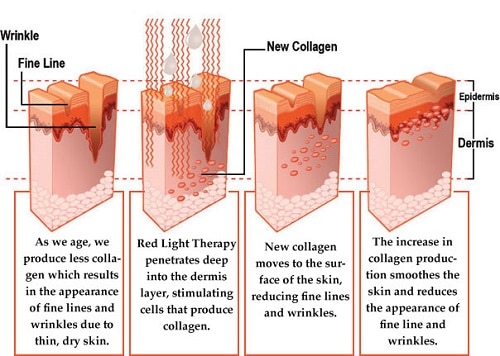
Visible red light used in skin studies usually ranges between 630-660 nanometers. Many devices also combine near-infrared light (around 810–850 nm).
Studies have shown that concentrated red light (no UV light is involved here) is absorbed by cell mitochondria and stimulates the production of collagen – the building block of your skin structure.
The heat and light boost blood circulation, bringing more blood and nutrients to all skin types.
It also promotes cytokine release (chemical messengers). As more cytokines are released, collagen-producing cells (called fibroblasts) leap into action.
- If your skin needs healing (from acne, acne scars, eczema, sun damage, redness, etc.), then the skin will heal naturally and faster.
- If it is already healthy, you will get a plumping effect, along with skin tightening, wrinkle reduction, and toned, radiant skin.
How Red Light Therapy Works on Skin
Red light therapy is shown to stimulate mitochondria within skin cells, increasing ATP production.
This is why red light therapy is not just cosmetic – it works at the cellular level.
The results of this mechanism may:
- Support collagen synthesis
- Improve circulation
- Reduce inflammatory signaling
- Promote tissue repair
This process is called photobiomodulation.
Is Red Light Therapy Safe for Your Skin?
Red light therapy does not use ultraviolet radiation and is not associated with UV-related DNA damage (study).
However:
- Always wear protective eyewear when using high-output panels or masks.
- Use eye protection
- Do not treat active infections without medical advice
- Consult a dermatologist for severe skin conditions
Can You Get Too Much Red Light Therapy?
Low-Level Laser Therapy, delivered through LED light, was found to have no side effects or risks to the skin.
Unlike high-power lasers used in clinics, infrared rays won’t burn your skin, won’t cause redness and inflammation, and the heat is almost unfelt during treatment.
Red light therapy is safe to use on your skin, as long as you follow instructions and don’t overdo it.
Red Light Therapy Skin Uses
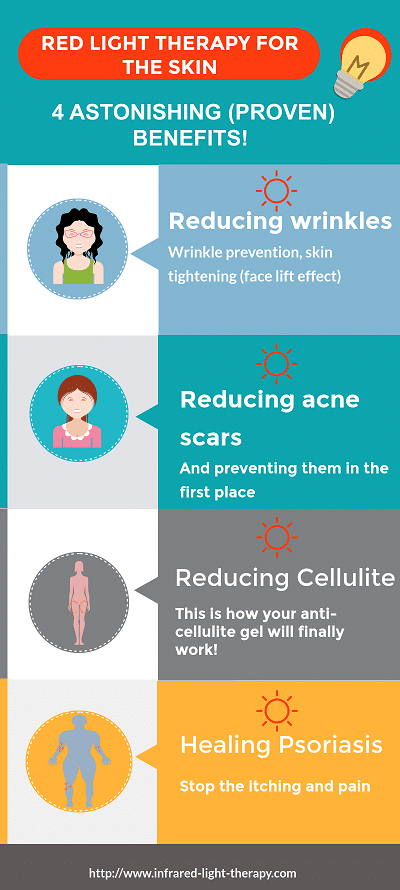
Here’s more about the proven benefits of red light therapy for your skin:
1. Skin Tightening & Wrinkle Reduction
Several small clinical studies have shown improvements in skin smoothness, elasticity, and fine lines after 8-12 weeks of consistent red and near-infrared LED treatments.
A 2007 study from the International Center for Cosmetic Medicine in Australia administered nine 20-minute duration red light treatments with a standard red light treatment home device (in the 633 and 830nm wavelengths).
The results:
“At 12-week follow-up, 91% of subjects reported improved skin tone, and 82% reported enhanced smoothness of skin in the treatment area.”
Notice that this study combined red light (633 nm) with infrared light (830 nm – invisible red light), as do most high-quality red LED light home devices (like this one)
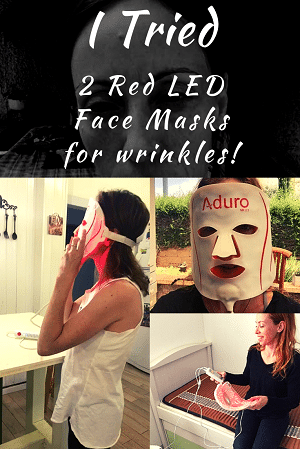
👉 I’ve tried 2 LED red light therapy face masks and the results are very good.
Want another example?
In A 2006 clinical study published in J.Drugs Dermatol Magazine, 36 subjects received 9 LED treatments (with both red and infrared wavelengths) over the course of 5 weeks and were evaluated after 12 weeks.
5 of them were also biopsied to see the ultrastructural changes in their collagen fibers.
The results:
“A statistically significant improvement in wrinkles was seen after profilometric analysis. The majority of subjects reported improvements in softness, smoothness, and firmness at all time points. Electron microscopic analysis showed evidence of post-LED treatment of thicker collagen fibers.”
Many more studies prove and explain the rising popularity of red light therapy face-firming treatment.
👉 See the 8 best LED light therapy masks (compared side-by-side)
How Long is a Home Treatment with Red Light Therapy?
Depending on the power of your home device, treatment time (for the entire face) can take up to 30 minutes (about 3-4 minutes per area).
If you need to treat your entire face, you’ll save a lot of time by using a small panel device, such as the Hooga Panel, which covers your entire face in one 3-minute treatment.
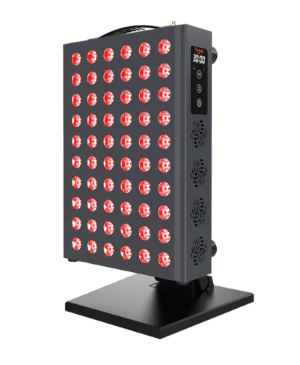
A handheld LED light therapy device will require moving the small treatment head from your cheeks to your forehead to your jowls, and so on, which lengthens treatment time. That’s why I do not recommend them anymore.
👉 See the best red light therapy devices for home use (and which one fits your goals)
Why I Prefer LED Face Masks for Skin Treatments
For facial anti-aging and overall skin tone improvement, LED masks are:
- Hands-free
- Evenly distributed
- Time-efficient
- Designed specifically for the facial contour
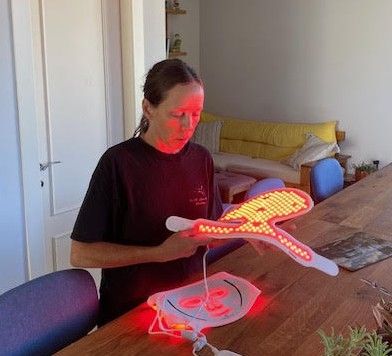
Through my research, they are the most cost-effective option of them all.
When Can You Expect Results?
Based on researching all clinical studies, you can expect the best results after at least 12 weeks of treatment.
The initial effect will be clearer, brighter, and tighter skin.
The long-term effect is improved skin clarity, texture, and tone, and a reduction of wrinkles, fine lines, and dark circles under your eyes.
Ideally, you’ll need 4 to 6 home treatments a week for the first 2-3 weeks, then at least 3 times a week for 3 months.
The more and longer you use it, the better results you’ll get. This is not a sprint, it’s a marathon.
2. Cellulite Reduction
Studies suggest low-level light therapy alone has a limited effect on cellulite.
However, when combined with massage or topical treatments, some trials show some visible reductions in thigh circumference.
When studies combined phototherapy with massage treatment, 71% of people with cellulite saw an almost 1cm reduction in cellulite in their thighs
When another study combined red light rays with a topical anti-cellulite gel, LLLT was able to bring about remarkable cellulite reduction.
👉 Read the full guide to red light therapy for cellulite (what actually works)
Here’s what this means for you:
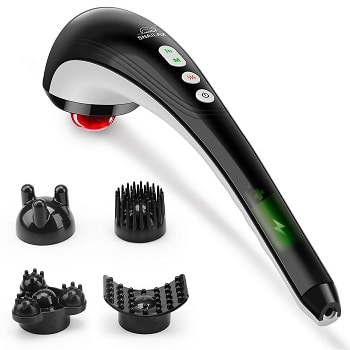
A red light therapy home device (or even better – an infrared massager) can turn your disappointing anti-cellulite gel into something that finally works!
(And these massagers are affordable!)
And also:
It can reduce the plaques associated with Psoriasis.
Some small clinical trials combining 633 nm and 830 nm wavelengths reported reductions in plaque severity in patients resistant to conventional treatment.
One of them included two 20-minute sessions, spaced 48 hours apart, for a total of 4 or 5 weeks.
The results showed:.
“All patients completed their LED regimens. Follow-up periods were from 3 to 8 months, except in two patients who were lost to follow-up. Clearance rates at the end of the follow-up period ranged from 60% to 100%. Satisfaction was universally very high.”
And here’s a thrilled Reddit user who found her cellulite completely gone after 6 months of full-body red light therapy:
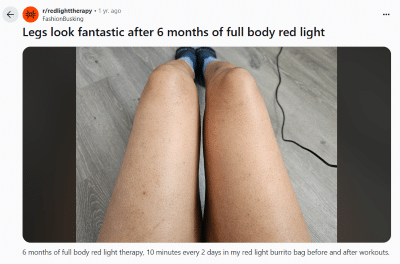
When you read her testimony, you’ll find that she also found new hair growth on her treated legs, proving that red light therapy for hair growth works!
3. Diminishing Acne Scars
Using red light therapy to treat your acne prevents scar tissue from forming in the first place.
However:
Even if you already have scars from acne, red light therapy can help fade them.
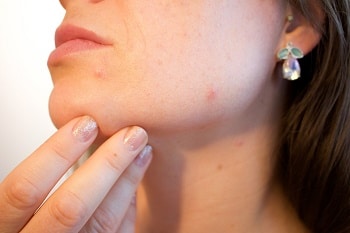
As new collagen is formed, the pockmarks often left by severe cases of acne even out, reducing the appearance of acne scarring.
This study has proven that near-infrared LED-treated scars showed significant improvement over the control scars on all measures of efficacy.
And, no side effects were reported.
Note: This treatment takes time. Give it at least a few weeks of daily treatments to see results.
If acne scarring is your main concern, devices combining red (630–660 nm) and near-infrared (810–850 nm) can offer broader tissue support.
👉 See how red light therapy may help rosacea (step-by-step guide)
How to Use Red Light Therapy at Home – According to Studies
Most skin-focused studies use:
- 630-660 nm (red light)
- 810-850 nm (near-infrared)
Common study protocols:
- 10-20 minutes per session
- 2-4 times per week
- 8-12 weeks
Consistency is more important than intensity.
Red Light Therapy vs. Laser Therapy
Red light skin therapy is Low-Level Laser Therapy (cold laser).
It uses much gentler light than medical laser procedures and does not remove or injure the top layer of your skin.
But:
Just because red light therapy is non-invasive and gentle does not mean that it can’t produce the same results as a high-power laser.
And the best news?
It’s safe enough to do it at home, by yourself, whenever you want to, and it can save dozens of dermatologist trips and a ton of money.
Conclusion
Red light therapy is a promising, non-invasive, pain-free, and natural treatment for a few of the most common skin problems.
It’s proven to work for chronic photo-damaged skin (wrinkles, fine lines, sagging), acne scars, cellulite, and psoriasis.
These days, you can save a lot of money (and time) on clinic sessions by having an FDA-cleared red LED light therapy home device to use 24/7 whenever you need it.
If you’re considering red light therapy for skin improvement, start with:
- The right wavelength
- A realistic 8–12 week plan
- Consistent sessions
When used correctly, it can be a powerful addition to your skincare routine.
👉 Compare the best at-home red light therapy devices here.
To your health and happiness,
Meital
Studies
Hernández-Bule ML, Naharro-Rodríguez J, Bacci S, Fernández-Guarino M. Unlocking the Power of Light on the Skin: A Comprehensive Review on Photobiomodulation. Int J Mol Sci. 2024 Apr 19;25(8):4483. doi: 10.3390/ijms25084483. PMID: 38674067; PMCID: PMC11049838.
Prophylactic low‐level light therapy for the treatment of hypertrophic scars and keloids: A case series
Photomedicine and Laser Surgery.Feb 2010, Combination 830-nm and 633-nm Light-Emitting Diode Phototherapy Shows Promise in the Treatment of Recalcitrant Psoriasis
Avci, Pinar et al. “Low-level laser (light) therapy (LLLT) in skin: stimulating, healing, restoring.” Seminars in cutaneous medicine and surgery vol. 32,1 (2013): 41-52.
Combined 633-nm and 830-nm led treatment of photoaging skin
This article is based on peer-reviewed dermatology research on photobiomodulation and low-level light therapy.
I’m concerned about the red light therapy burning subcutaneous fat as I’m on the thin side so I want to keep my fat /plumpness where I can. Can anybody help with any info? Thanks so much.
Red light therapy is not supposed to do that. Infrared light therapy is used to burn white fat, see this post about infrared sauna for weight loss.
Should my skin be completely clean during treatment? I’m assuming no makeup, but what about moisturizers or other creams? Thanks.
Yes, completely clean, with no moisturizers and other creams. You can use the best serums for LED light therapy – after your treatment.
I have used the Red Light therapy beds at the tanning salon. I used this twice a week, while working out, eating fairly cleanly, at home self facia massage, and drinking gallons of water. Within about 3-4 months all the cellulite on my legs was virtually undetectable!… and I am over 50. I definitely saw results!
Terri that’s awesome! Thanks so much for sharing this with us so now other women know it works :)
I have been using Red Man light bulb that is 670 but it isn’t doing anything for me. I have been using it for over a mo th.
I am tho thinking of buying something else.
You may want to consider a LED face mask. From personal experience, it works.
Will it promote hair growth on face. I see it is used for promoting growth on heads. I certainly don’t want facial hair growth…
To my knowledge it won’t promote hair growth where hair is not “supposed” to grow. I’ve been using red light therapy on my facial skin for months and I have no side effects, including hair growth… :)
What’s the definition of ‘overdoing’ it?
Overdoing red light therapy would be to use it more than the specific instructions for each device. Generally, for more than 25 minutes 4-5 times a week, and more than once a day.
Hi. I have been using red light for about two weeks. Is it normal to have some pigmentation appear? Is it rising to leave the skin similar to IPL?
Some people experience a little pigmentation on their skin. According to studies, this may be caused of overuse or not cleaning the skin well before treatment. If used properly, LLLT should not cause pigmentation, but reduce it.
See this study.
Is there a product that has both the red light therapy and infrared? I would like to offer it to my massage clients for pain relief and anti aging benefits? If so, what’s a great one you recommend?
The Revive light therapy system has both red & infrared wavelength, and can be used for anti-aging and pain relief. It has 96 infrared bulbs (880nm), 32 dark red (660nm), 32 red (630 nm) and 32 amber bulbs (530 nm). Get all the details in my Revive light therapy reviews post :)
I have seen several. One is the Revive handheld. I saw some reviews on YouTube about it. It looks pretty good!